
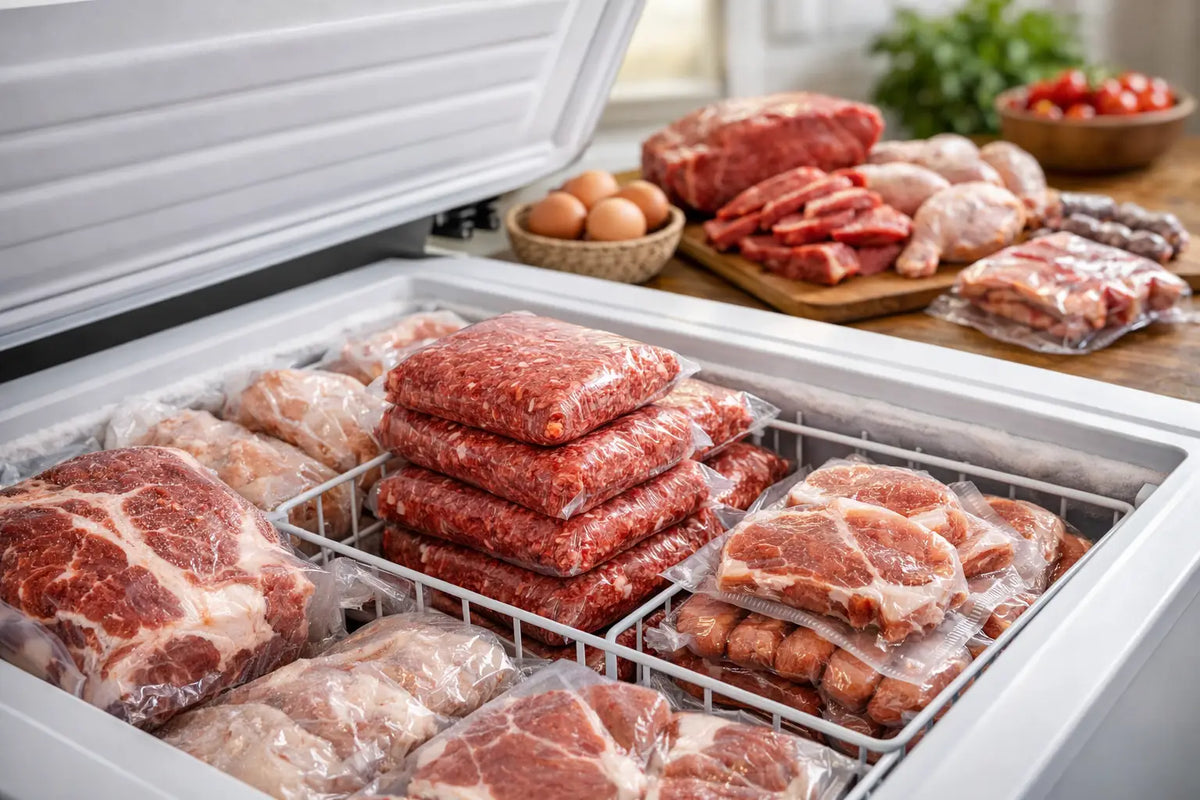
A family freezer always sounds like a simple idea until you are staring at a pile of mince, chicken fillets, sausages and roasting joints wondering where it all goes. If you are trying to work out how much meat for a family freezer makes sense, the honest answer is that it depends on how your household actually eats, not just how many people live in it.
Some families get through meat every night of the week. Others mix in pasta dishes, fish, vegetarian meals, takeaways and meals out. That is why freezer buying works best when it is based on real habits rather than guesswork. Buy too little and you are back to topping up every few days. Buy too much and good meat gets buried at the bottom until it is forgotten.
How much meat for a family freezer depends on three things
The first is household size, but that is only part of it. A family of four with young children will eat very differently from a family of four with two hungry teenagers. The second is how often you cook meat-based meals in a normal week. The third is your freezer space, because there is no point buying a half-butchery shop if you are trying to squeeze it into the ice box above the fridge.
As a rough working guide, many families use between 500g and 1kg of meat per day across the household when cooking a main meal. That range sounds wide because it is. A chicken stir-fry with plenty of veg might use far less than a roast dinner, a barbecue or a slow-cooked beef dish with leftovers.
For a family of four, a sensible monthly estimate often lands somewhere between 15kg and 25kg of meat if meat is the centre of most evening meals. If you are planning to stock the freezer for two months, that usually means 30kg to 50kg. For three months, 45kg to 75kg is often enough. That is a broad range, but broad is better than unrealistic.
Start with your weekly routine, not a bulk deal
Before buying in quantity, think about what you actually cook in an average week. If your household regularly eats spaghetti bolognese, chicken curry, sausages and mash, a roast on Sunday and a couple of quick midweek traybakes, your freezer should reflect that pattern.
A practical way to plan is to count your usual meat meals for one week, then multiply up. If you cook five meat-based dinners a week and each one uses around 800g to 1kg for the family, you are looking at roughly 4kg to 5kg a week for evening meals alone. Add bacon for breakfasts, sandwich meats, barbecue bits or extra portions for lunches, and the figure climbs fairly quickly.
This is where people often go wrong. They buy for an imagined version of family life where everyone cheerfully eats lamb steaks on a Tuesday and a large roasting joint every weekend. In reality, the freezer needs to support the meals you genuinely rely on when work is busy and time is short.
A good freezer mix for most families
If you are stocking up properly, variety matters as much as quantity. Freezers filled with all mince or all chicken become hard work after the first couple of weeks. Most households are better served by a balanced mix of everyday staples and a few larger cuts.
For many families, mince is the backbone of the freezer because it turns into cottage pie, chilli, burgers, meatballs and bolognese without much fuss. Chicken fillets or thighs earn their place for quick midweek meals. Sausages and bacon are useful because they stretch across breakfasts, traybakes and simple suppers. Then it helps to have a few roasting joints, pork chops, lamb pieces or stewing beef for weekends and slower cooking.
A one-month family freezer for four might sensibly include 4kg to 6kg of mince, 4kg to 5kg of chicken, 2kg to 3kg of sausages, 1kg to 2kg of bacon, 2kg to 4kg of roasting or slow-cooking joints, and another 2kg to 4kg spread across pork, lamb or burgers. That would not suit every household, but it is a practical shape for many.
Portion size makes a bigger difference than people expect
If you want a more accurate answer to how much meat for a family freezer, look closely at portion size. Adults usually eat more than children, and older children often eat more than expected. A rough guide for a family meal is around 150g to 250g of meat per adult and 75g to 150g per child, depending on the cut and the dish.
That means a curry for two adults and two younger children may only need 500g to 600g of diced chicken once rice and vegetables are added. A roast dinner with leftovers in mind might call for 1.5kg or more. A barbecue can easily use far more than a normal evening meal because people graze.
This is why freezer planning by “number of packs” can be misleading. Ten packs of meat sounds plenty until you realise each pack only feeds two people comfortably. It is better to think in meals and portions than packets.
Freezer size sets the real limit
There is also the practical question of where this meat is going. Chest freezers hold far more than upright freezer drawers, but they can make it easier to lose track of what you have. Drawer freezers are easier to organise, though they fill up fast with bulky packs and joints.
As a rough guide, a small under-counter freezer will not usually hold enough for a heavily stocked family meat supply unless you shop little and often. A standard upright freezer can often manage a month or two of mixed family meat if packed sensibly. A chest freezer gives you far more flexibility for bulk buying, larger joints and seasonal stocking.
Space matters for another reason too. Meat freezes best when packed neatly, labelled clearly and rotated properly. If the freezer is crammed so tightly that older items disappear underneath new ones, waste starts creeping in. A proper stock-up should make life easier, not turn dinner into an archaeological dig.
Buying more is not always buying better
There is a point where bulk buying stops being good value. If you fill the freezer with cuts your family does not really enjoy, or with far more than you can sensibly use within a few months, the savings disappear. Good butcher’s meat is worth stocking, but only if it gets cooked and eaten.
That is why curated freezer packs often work well. They take out some of the guesswork and give households a sensible spread of everyday cuts rather than too much of one thing. For busy families in Essex, that sort of practical mix can be far more useful than chasing the biggest possible haul.
It is also worth thinking seasonally. In summer, you may want more burgers, sausages, chicken kebabs and barbecue-friendly cuts. In colder months, mince, braising steak, roasting joints and pies tend to earn their keep. The best family freezer changes with the way you cook through the year.
When to buy a little extra
There are times when buying more meat makes perfect sense. If you have older children, batch cook regularly, host Sunday lunch, or prefer fewer shopping trips, it is usually worth keeping a deeper freezer. The same applies if you like having back-up meals on hand for busy weeks.
In those households, three months of meat can be realistic if the freezer space is there and the stock is organised. If that sounds like your setup, aim for enough staples to cover the core meals first, then add extras such as burgers, steaks or special-occasion joints.
If you are only just starting out, be more conservative. A month of well-chosen meat is usually better than a freezer overstuffed with good intentions.
A simple way to work it out
If you want a straightforward method, keep track of your meat use for two weeks. Note what you cooked, how much was used and whether there were leftovers. Multiply that by four for roughly two months, or by six for about three months, then sense-check it against your freezer space.
That gives you a much more reliable figure than any generic chart. It also helps you buy in a way that suits your family properly. Some households need more chicken and mince. Others want roasting joints, chops and bacon in steady supply. There is no badge for buying the most. The goal is to have the right amount on hand, kept properly, and ready when you need it.
A well-stocked freezer should feel reassuring, not excessive. When you get the balance right, supper is easier to plan, waste stays low, and there is always something decent to cook at the end of a long day.

Share:
What Meat to Order for a BBQ
Which Cuts Are Best for Slow Cooking?