
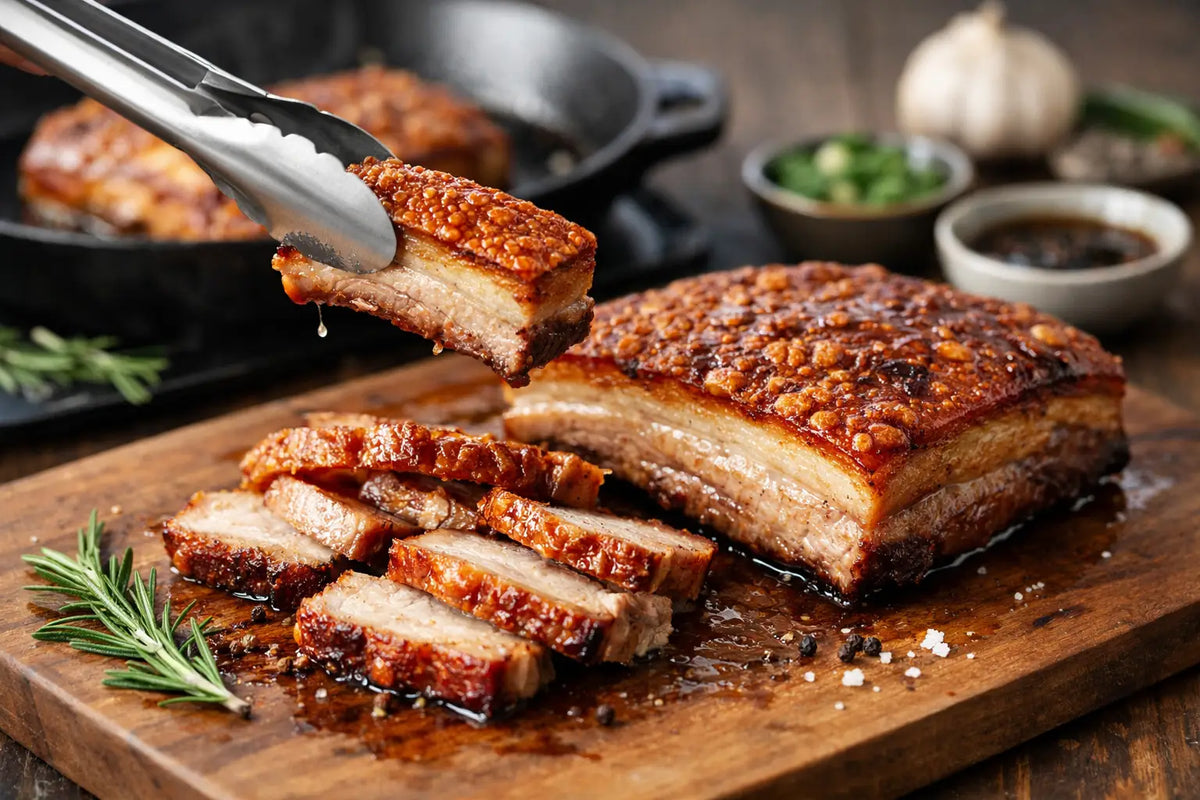
Pork belly can be one of the best cuts on the table or one of the most disappointing. When it is cooked well, you get crisp crackling, rich flavour and soft, succulent meat. When it is rushed, you get chewy skin and fat that has not quite rendered. If you have ever wondered how to cook pork belly properly at home, the good news is that it is not difficult - but it does reward a bit of patience.
This is a cut with real character. It has layers of meat and fat, so the aim is never simply to cook it through. You want to render the fat slowly, keep the meat moist and finish with skin that has properly crackled. The right method depends on whether you are cooking a whole slab for a roast, sliced pork belly for quicker meals, or slow-cooking it until it nearly falls apart.
How to cook pork belly for the best result
For most home cooks, roasting is the best place to start. It gives you the balance most people want - crisp skin on top and tender meat underneath. A whole piece of pork belly, ideally with the skin already scored, is the easiest version to manage.
Before it goes anywhere near the oven, the skin needs to be dry. This matters more than any fancy seasoning. Pat it well with kitchen paper, then leave it uncovered in the fridge for a few hours if you have the time. Overnight is even better. Dry skin crackles; damp skin steams.
When you are ready to cook, rub salt into the skin and season the underside with whatever you like. Keep the seasoning simple if you want the pork flavour to do the work. A little black pepper, fennel, garlic or thyme all sit well with belly pork, but you do not need to overcomplicate it.
Start the pork belly in a hot oven at around 220C, or 200C fan, for 25 to 30 minutes. This helps the crackling get going. After that, reduce the heat to 160C to 170C and continue cooking for roughly 1 hour 30 minutes to 2 hours, depending on the size and thickness of the joint. As a rule, you are looking for meat that feels tender when pierced and fat that has softened rather than stayed rubbery.
If the crackling needs more colour at the end, turn the heat back up for another 10 minutes, but keep a close eye on it. Crackling can go from perfect to burnt quickly.
Resting is not optional. Give the pork belly at least 15 minutes before carving. That pause helps the juices settle and makes slicing much easier.
Preparing pork belly before cooking
A good result starts with the cut itself. Pork belly should look well layered, with a decent balance of fat and meat. Too lean, and it can dry out. Too fatty, and you may end up with plenty of richness but not enough bite. This is where buying from a proper butcher helps, because you can ask for a piece suited to roasting, slicing or slow cooking.
Scoring is another point worth getting right. The skin should be scored through the skin but not deeply into the meat. If the cuts are too shallow, the fat will not render as well. Too deep, and the juices can bubble up and soften the crackling. Many customers prefer to have this done for them, which is often the neatest option.
It is also worth bringing the pork closer to room temperature before cooking. About 30 to 45 minutes out of the fridge is usually enough. If it goes into the oven absolutely fridge-cold, it can cook less evenly.
Salt, oil and seasoning
There is often debate about whether to use oil on the skin. A little can help the salt stick, but too much can work against you. Pork belly has enough fat of its own. In most cases, dry skin and a generous rubbing of salt are what matter most.
For the meat side, you have more room to play. If it is a family roast, keep it traditional. If you are serving it with mash, greens or roasted vegetables, herbs and garlic work nicely. If you are heading towards an Asian-style dinner, a marinade with soy, five spice and a touch of honey can be excellent, though sugary marinades should stay off the skin if you want proper crackling.
Slow-cooked pork belly
If crisp crackling is not the priority, slow cooking is another excellent way to handle this cut. It suits colder days, batch cooking and meals where you want the meat soft enough to pull apart with a spoon.
To slow-cook pork belly, place it in a roasting tin or casserole with a little stock, cider or even just a splash of water, cover it tightly and cook at around 140C to 150C for 3 to 4 hours. The exact timing depends on thickness, but the goal is tenderness rather than speed.
Some people remove the skin before slow cooking and crisp it separately later. Others cook the belly with the skin on, then uncover it and finish under higher heat to try to crisp the top. Both approaches can work, but the skin is rarely as good as it is with a proper roast from the start. That is the trade-off. Slow cooking gives exceptional tenderness, while roasting gives better crackling.
For everyday family meals, slow-cooked pork belly is particularly useful because leftovers reheat well. It also works brilliantly in buns, with rice, or alongside buttery mashed potatoes and seasonal greens.
How to cook pork belly slices
Pork belly slices are quicker, easier and often better suited to midweek cooking. They do not usually need the same long roasting time as a whole slab, and because they have more exposed surface area, they pick up flavour quickly.
You can roast slices at 180C for around 35 to 45 minutes, turning once so the edges colour evenly. They are also excellent in a frying pan started on a medium heat to render some fat, then finished in the oven. This gives you more control over browning and texture.
The main thing with slices is not to overcrowd the tray or pan. If they are packed too tightly, they will sweat rather than roast. Leave a bit of space around each piece so the heat can do its job.
For a sticky glaze, add it near the end rather than at the beginning. That way, you get caramelisation without burning the sugars.
Common mistakes with pork belly
Most pork belly problems come down to one of three things: not drying the skin properly, cooking at the wrong temperature, or not allowing enough time.
If the crackling is chewy, the skin was probably too wet or the heat too low at the start. If the meat is tough, it often needs longer. Pork belly is not a cut that responds well to impatience. If the fat is still thick and rubbery, it has not rendered enough.
Another mistake is carving too soon. Straight from the oven, the juices are still moving through the meat. A short rest makes a noticeable difference.
Finally, there is the temptation to trim away too much fat before cooking. With pork belly, that fat is part of the point. As it renders, it bastes the meat and carries flavour. You want it to cook down, not disappear completely.
What to serve with pork belly
Because pork belly is rich, it benefits from sides that bring contrast. Roast potatoes are an obvious match if you are serving it as a Sunday roast, but sharp apple sauce, braised red cabbage or mustardy greens help cut through the richness.
For a slower-cooked version, softer sides work well. Mash, buttered savoy cabbage or even simple carrots are enough. If you have cooked the pork with Asian flavours, plain rice, spring greens and a quick cucumber salad give the meal some balance.
That balance matters. Pork belly should feel generous, not heavy.
Choosing the right cut
If you are cooking for guests, a neat, even piece is easier to roast and carve. If it is for a relaxed family meal, slices can make life much simpler. And if you know you want pull-apart texture rather than clean slices, ask for a piece suited to slow cooking.
At Reed's Family Butchers, this is exactly the sort of cut where a bit of advice goes a long way. A proper butcher can tell you which piece will suit your oven, your timing and the sort of meal you actually want to put on the table.
Pork belly is not difficult, but it does ask you to slow down and cook with a bit of care. Get that right, and it rewards you with one of the most satisfying roasts you can make at home.

Share:
10 Best Butcher Products for Christmas
How to Choose a Roasting Joint